Next story?
Create a room.
Free, no sign-up, ready in seconds.
Seat your own AI assistant at the planning poker table. It plays a card and gives a reason like a teammate, and nobody sees either until the reveal, so its number can't anchor the team. Free, with no account.
Connect your assistantClaude, Claude Code, Cursor, ChatGPT or VS Code, over MCP. No account, no API key.
Set it upThe room's AI assistant menu has the request ready to copy. The host or a facilitator seats it.
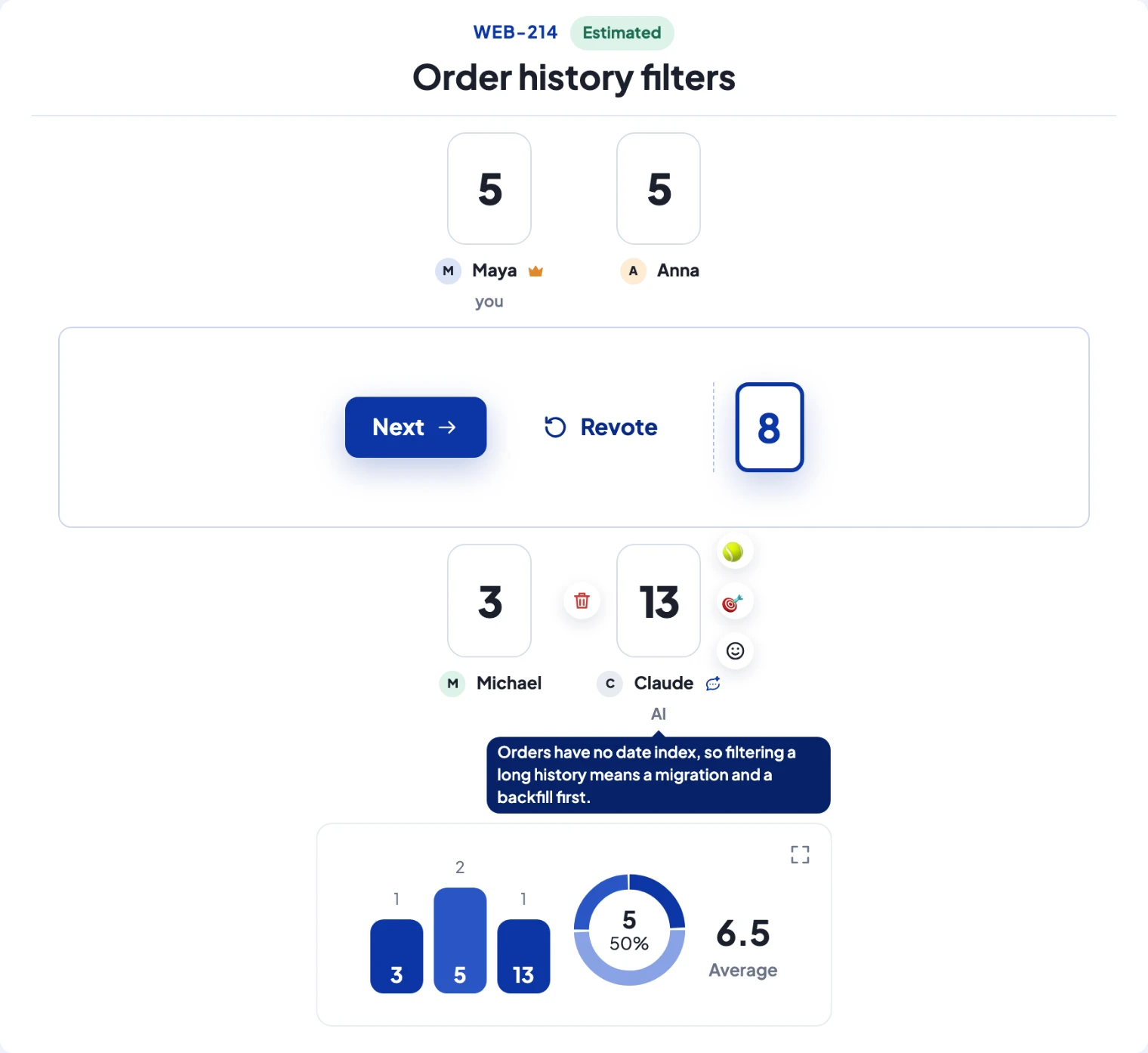
It plays its own card and a short reason on each story. Nobody sees either until the reveal.
Its card and reason turn over with everyone's, so a card far from the rest is something to check.
A suggestion on screen while people vote pulls their cards towards it, and the disagreement that would have shown a gap goes quiet. So Estimay shows none.
No tool shows it anyone's card before the reveal, and the room shows nobody its card or reason.
It sits apart from you, marked AI. Only the person who added it can play it, and it never holds up auto-reveal.
Its card counts in the numbers like anyone's, and the host can save the estimate the team agrees on.
Each of these runs on your assistant, when someone asks for it.
Before the vote: edge cases, missing acceptance criteria, risks and possible splits, with no sizes.
AI backlog refinementAfter the reveal: the stories whose votes were far apart, as questions for the team.
After the round: the agreed numbers go to Jira, Trello, Linear, Asana or GitHub through the room's connection.
IntegrationsExtra questions for AI tokens and Agent-ready sit next to the points, answered by people or your assistant.
Planning poker for AI teamsEstimay runs no AI model of its own, so there are no credits to buy and no AI provider of ours to approve.
Your assistant picks the card. Run it inside your repository and it can read the code a story touches.
What the person who connected it could see in the room. That reaches their assistant's provider, so share only what your organisation allows.
Remove an assistant from Connected assistants and its access ends.
Connected assistantsAn AI assistant gives its own estimate of a story next to the team's. In Estimay it plays like another player: it picks a card from the room's deck, adds a short reason, and both stay hidden until the reveal.
Yes. It goes into the average and the saved estimate like anyone's, so talk it through and set the number the team agrees on. If you would rather keep it out of the numbers, don't seat it: ask your assistant for its view after the reveal instead.
Not in the room. The person running the assistant might, because many assistants show a tool call's arguments on screen, and those include the card and the reason. If you are voting too, play your card first, or have a facilitator who isn't voting seat it.
The title, the description, the discipline and the link. An imported story brings its description from your tracker unless the import left it out; an assistant with access to your tracker can open the item through the link for the rest, and one running in your repository can read the code. With only a title to go on, its card is worth about that much.
Estimay doesn't charge for it: there are no AI credits, no API key and no account. Any usage is on your own assistant's plan.
No, because Estimay runs no AI model of its own. A room with no assistant connected works as it always does, with only people at the table.